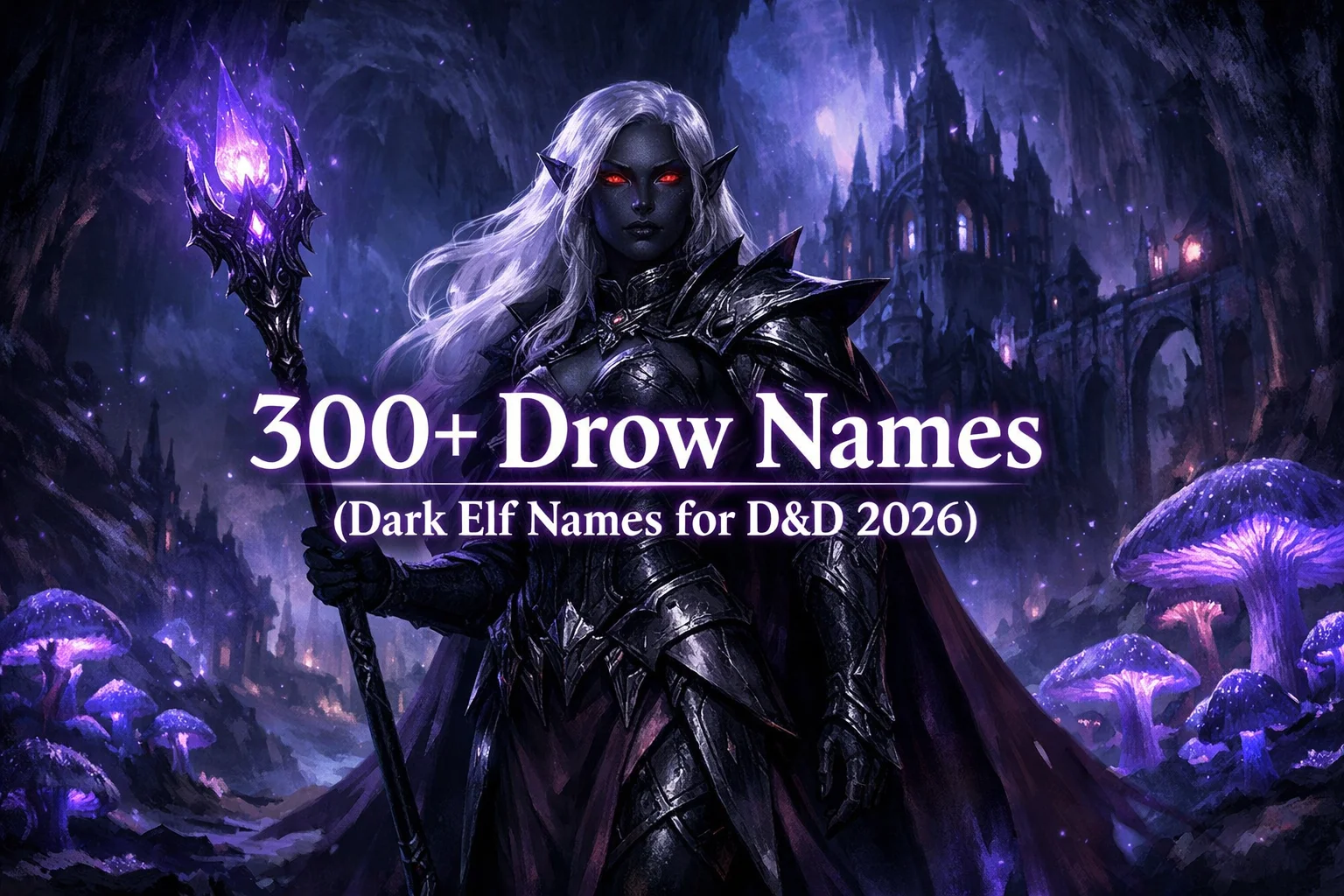
Drow names follow a specific phonetic logic rooted in the fictional Drowic language developed across decades of Forgotten Realms lore and once you understand that logic, naming your dark elf character becomes a completely different experience. Female drow names favor flowing, sibilant sounds: ss, qu, yr, rae. Male names run shorter and harder: zak, jar, riz, val. Noble house names carry apostrophes that signal matrilineal descent and station. This isn’t random fantasy noise it’s a constructed naming system with real internal rules.
Below you’ll find 300+ drow names organized by gender, house, and purpose, each explained with meaning, lore context, and why it works for D&D 5e, Baldur’s Gate 3, or your own worldbuilding.
What Makes Drow Names Different from Other Elvish Names?
Most people assume drow names are just “dark versions” of standard Elvish they’re not. Standard High Elvish (Tolkien-influenced Sindarin and Quenya) leans musical and vowel-heavy: Legolas, Galadriel, Celeborn. Drow names, by contrast, come from Drowic the subterranean dialect of Dark Elvish codified in D&D’s Forgotten Realms setting, primarily shaped by Gary Gygax’s original Monster Manual (1977) and massively expanded by Ed Greenwood and R.A. Salvatore.
The phonetic signature of Drowic is deliberate. Sibilants (s, ss, z) dominate, evoking whispers and shadows. Hard consonants k, v, d, r break the softness with sudden force. Apostrophes in surnames mark clan boundaries and matriarchal lineage, since drow society in the Forgotten Realms is structured around noble matriarchies loyal to the spider goddess Lolth. A name like Malice Do’Urden reads as “Malice of the Do’Urden house” the apostrophe isn’t decorative punctuation, it’s a grammatical marker of belonging.
This is what I love about drow naming as a system: it’s not just aesthetic. Every structural choice reflects the culture.
Female Drow Names — With Meanings and Lore
Female drow names are the most prestigious in drow society. Priestesses of Lolth hold the highest power, and their names reflect status, threat, and beauty simultaneously. These names tend to be longer than male names four or more syllables with flowing sounds that mask the menace underneath.
Vierna — From the Drowic root meaning “silver flame,” associated with priestess rank. R.A. Salvatore used this name for Drizzt Do’Urden’s sister, making it one of the most recognized drow names in fantasy fiction. Writers love it because it sounds elegant without losing its edge.
Quenthel — A name signifying “chosen of Lolth” in Forgotten Realms lore, carried by Quenthel Baenre, Matron Mother of House Baenre. The hard qu at the start is pure Drowic it doesn’t exist in surface Elvish phonology at all.
Sorn — Short, sharp, and ranked. Originally a title-name meaning “stone-heart” used for female warriors who proved themselves in battle. I love it for characters who’ve crossed a moral line and kept walking.
Malice — One of the most famous drow names in fiction, borne by Malice Do’Urden, Drizzt’s mother and Matron Mother of his house. It’s an English word repurposed as a proper name which actually fits drow naming conventions, where surface words sometimes enter the lexicon through decades of contact.
Yvonnel — The name of two legendary Matron Mothers of House Baenre, considered the greatest matriarch in drow history. The double-n and liquid l ending mark this as high-status. Yvonnel Baenre ruled for over 700 years in-lore. That’s a name with weight.
Liriel — A softer drow name, used for characters who straddle the surface and Underdark worlds. It carries an almost High Elvish quality appropriate for characters with complicated heritage.
Zeerith — From the Drowic construct meaning “she who endures,” used by House Xorlarrin. Zeerith Q’Xorlarrin is notable for relocating her house to Gauntlgrym. Complex political characters deserve complex names.
Sshamath — More of a place-name appropriated as a personal name, but used by drow female mages who studied at the wizard city of the same name. The double-ss opening is very Drowic.
Triel — Short, dangerous, unexpectedly delicate. Triel Baenre served as high priestess before becoming Matron Mother. Names that end in -iel feel like they’re borrowing from High Elvish just enough to unsettle you.
Nathrae — Constructed from Drowic roots meaning “born in shadow.” The -rae ending is a feminine suffix in the Drowic dialect used in Menzoberranzan.
Here are 80 more female drow names, organized by vibe:
Priestess-class female drow names (formal, high-status)
| Name | Meaning / Notes |
|---|---|
| Akordia | “Lolth’s chosen hand” |
| Arlyss | “Silver-tongue, first speaker” |
| Baelryn | “Bound to the abyss” |
| Charinida | “Weaver of fates” |
| Dalharil | “Daughter of darkness” |
| Edyrm | “Iron will, unbroken” |
| Faerzress | Named for the magical radiation of the Underdark |
| Guldra | “Gilded hunger” |
| Halavin | “She who does not forgive” |
| Ilivara | “Sacred to Lolth” |
| Jalynfein | “Jade-eyed deceiver” |
| Karliress | “Cold water, cold heart” |
| Laele | “Servant of the night” |
| Myrymma | “Twice-cursed, twice-blessed” |
| Neldoryn | “Web-born” |
| Ordulae | “She who judges” |
| Pellanistra | “Pale mistress” |
| Quave | “Silent blade” |
| Ryntala | “Red stone, red hand” |
| Syrzan | “Serpent-kissed” |
Warrior and rogue female drow names (sharp, fast)
| Name | Meaning / Notes |
|---|---|
| Aelreth | “Swift kill” |
| Brizzt | Female variant of the famous Drizzt root |
| Chaszmyr | “Chaos-born” |
| Dhavra | “Blade-dancer” |
| Exzara | “Exile made strong” |
| Felynrae | “Cat-footed shadow” |
| Ghaunadra | “Touched by Ghaunadaur” (rival god of the Underdark) |
| Ilzimmer | “Deep stone hunter” |
| Jhannyl | “First blood” |
| Kelvarra | “Red-veined obsidian” |
| Lueldra | “Spider-quick” |
| Myrrath | “Moving darkness” |
| Nilvarra | “Poisoned arrow” |
| Oblodra | House name used as personal name — carries connotations of psychic power |
| Phyrra | “Flame without warmth” |
| Ryld | Traditionally male but used by female fighters in some campaign settings |
| Szordrin | “Twice-betrayed” |
| Tathlyn | “Sharp as obsidian” |
| Ulvyra | “Wolf-blooded” |
| Valindra | “Iron maiden” — also used as a lich name in the Forgotten Realms |
Rogue/mage female drow names (mysterious, arcane)
| Name | Meaning / Notes |
|---|---|
| Azzindra | “Star-shadow” |
| Bhaerynden | Ancient name referencing the drow’s pre-Underdark homeland |
| Cylarra | “Moonless eye” |
| Delmuth | “Silent purpose” |
| Ellyrisk | “Unread rune” |
| Falyn | “Half-light wanderer” |
| Gauntrae | “Iron web” |
| Haszra | “Hissing dark” |
| Ildara | “Illusion-born” |
| Jhulae | “Dreaming poison” |
| Kraeshna | “Void-touched” |
| Lyssara | “Memory of fire” |
| Meldara | “Mind-weaver” |
| Nightshadow | Surface-adapted alias used by drow spies |
| Oryndae | “Oracle of Lolth” |
| Peregrine | Surface alias — ironic for a drow who can never truly fly free |
| Quelarra | “Whispered command” |
| Ryvvikael | “Living shadow” |
| Seregirn | “Blood-thread” |
| Thalindra | “The unseen hand” |
Additional female drow names (for writers and D&D players)
Ulvara · Veldrin · Welverin · Xullrae · Ysolde · Zilvara · Amalrae · Bhyrn · Corym · Dalhazel · Elaraith · Fyrendel · Grayshadow · Haszyvra · Imrae · Jyslin · Karlen · Lyssivra · Mynafrae · Naelra · Ossra · Phaervyre · Qivlyn · Rythala · Ssivrix · Thalara · Uldryn · Vraedda · Waervyn · Xivrin · Yazara · Zylvara
Male Drow Names — With Meanings and Lore
Male drow names run shorter. In a matriarchal society where males hold secondary status, names are less ornate built for efficiency, not ceremony. That said, exceptional males (like Drizzt Do’Urden himself) carry names that hint at greatness despite the cultural context.
Drizzt — The most famous drow name in fiction. Created by R.A. Salvatore for his 1988 novel Homeland, Drizzt Do’Urden is the dark elf who rejected Lolth and sought a moral life on the surface. The name has no direct translation but phonetically fits the Drowic hard-consonant male pattern perfectly. What I find fascinating: Salvatore has said in interviews that he invented the name to sound “like nothing else” and 35 years later, it still doesn’t.
Zaknafein — Drizzt’s father. A weaponmaster of extraordinary skill who secretly opposed Lolth’s ways. The name carries Drowic roots suggesting “edged purpose” or “razor dedication.” For a character who was a brilliant fighter constrained by a corrupt society, it’s a perfect fit.
Jarlaxle — Mercenary leader of Bregan D’aerthe, the famous drow mercenary company. His name is one of the few male drow names that sounds almost joyful the -axle ending is unusual in Drowic, which might explain why he’s the most unorthodox drow in Salvatore’s canon. The name suits a man who plays by no one’s rules.
Rizzen — A common lower-class male name in Menzoberranzan, often shortened to Riz in informal use. Good for characters with street-level origins who clawed their way up.
Pharaun — Mizzrym house wizard, featured in The War of the Spider Queen series. A name associated with arcane intellect and sharp-tongued wit. The Ph- opening is rare in Drowic male names, giving it a slightly elevated feel.
Berg’inyon — Warrior son of House Baenre. The apostrophe divides what might otherwise be a surface name (Berg) from a drow suffix (inyon), creating a hybrid that signals complex lineage.
Valas — Short, hard, complete. A scout name. Valas Hune from The War of the Spider Queen is a ranger-type, and the name fits: two syllables, nothing wasted.
Ryld — Weapons master of Sorcere in Menzoberranzan. One syllable. That tells you everything about how this society treats male fighters you’re a tool, not a person, and your name reflects that economy of expression.
Solaufein — From Baldur’s Gate II, a morally complex drow warrior who questions Lolth’s priestesses. The name feels almost noble longer than most male drow names, suggesting education or ambition. Players who romanced Solaufein in BG2 still remember this name 25 years later. That’s naming done right.
Here are 80 more male drow names:
Noble house male drow names (status-bearing)
| Name | Meaning / Notes |
|---|---|
| Alton | Lower-rank Baenre male; one of the few with an almost human-sounding name |
| Bregan | As in Bregan D’aerthe “orphan army” in Drowic |
| Carolk | “Stone fist” |
| Dinin | Drizzt’s brother a name that sounds almost kind, which makes his betrayals worse |
| Erevis | Associated with the arcane; carries scholar connotations |
| Felstran | “Cold river” |
| Gromph | Archmage of Menzoberranzan. The name is intentionally ugly blunt, hard, arrogant |
| Halisstra | Male variant of a usually female name, used for characters in liminal roles |
| Invidian | “One who envies” named for their defining trait |
| Jeggred | The half-demon draegloth son of Triel Baenre a name that sounds broken and violent |
Warrior male drow names
| Name | Meaning / Notes |
|---|---|
| Kelnozz | “Trained killer” — a sparring partner of Drizzt’s in the Academy |
| Liriel | Used rarely for males; usually female, but appears in some campaign lore |
| Masoj | “Cold purpose” — the Hun’ett family mage who tried to kill Drizzt |
| Nathrak | “Thunder-step” |
| Orryn | “Silent approach” |
| Pellanozz | “Pale fist” |
| Quevven | “Quick and gone” |
| Ravel | “Unraveler” — great for chaotic neutral characters |
| Szordrin | “Twice-betrayed” (also female variant) |
| Tevelice | “Edge of the web” |
Rogue and assassin male drow names
| Name | Meaning / Notes |
|---|---|
| Ulvein | “Wolf-shadow” |
| Veldrin | Surface alias meaning “shadow”; used by Drizzt when traveling incognito |
| Wenth | “Patient death” |
| Xullrae | Male use of typically female suffix; marks gender-ambiguous characters |
| Yvras | “Venom-handed” |
| Zarith | “Living blade” |
| Adaric | “Dark dreamer” |
| Belthan | “Bound by blood” |
| Crimdrak | “Crimson shadow” |
| Daermon | As in Daermon N’a’shezbaernon — the true name of House Do’Urden |
Additional male drow names
Elkantar · Fedleth · Galverra · Haszyn · Iltryd · Jalarak · Kalnafein · Lhorzak · Myrym · Nalvyn · Oblodrath · Phyreth · Quelzarn · Rylthar · Szaryx · Thalvyn · Urdolin · Varzak · Welvryn · Xarann · Yrlath · Zelvyn · Aluvyn · Blaedar · Corvyn · Delvrak · Elryn · Faernzak · Gelvrak · Halreth · Ilzrak · Jarvyn · Kalzeth
Drow House Names and Last Names
Drow noble house surnames are among the most complex naming elements in all of D&D lore. They’re not just family labels — they’re political declarations. Carrying a house name means belonging to a power structure with enemies, alliances, and Lolth-ordained rank. Losing a house name means social death.
The apostrophe in drow surnames marks a linguistic break between a descriptive element and a clan identifier. Do’Urden means roughly “of the dark blade” Do being a possessive particle and Urden meaning “blade” or “edge.” N’a’shezbaernon is the ancient, true name of House Do’Urden longer, older, more sacred than the common-use name.
Here are 60 drow house names for D&D campaigns and worldbuilding:
Established Forgotten Realms Houses (canon): Baenre · Do’Urden · Mizzrym · Fey-Branche · Xorlarrin · Agrach Dyrr · Barrison Del’Armgo · Oblodra · Faen Tlabbar · Tuin’Tarl · Hun’ett · DeVir · Horlbar · Symryvvin · Kenafin · Freth · Vandree
Original house names (for homebrew campaigns):
| House Name | Suggested Meaning |
|---|---|
| Vaerindra | “Web of iron” |
| Nylssath | “Poison-born lineage” |
| Xolvareth | “Void inheritors” |
| Szordrath | “Betrayal made noble” |
| Quelvreth | “Whisper dynasty” |
| Thalindros | “Shadow throne” |
| Ilvyrn | “Dark star bloodline” |
| Myraxle | “Chaos-crowned” |
| Pelzareth | “Cold stone legacy” |
| Uldraeth | “Wolf-house of the deep” |
| Vorzakath | “Edged purpose, ancient” |
| Dhavrath | “Dancer’s blood” |
| Carolvyne | “Stone fist lineage” |
| Faelzryn | “Half-light inheritors” |
| Grayshadow | Surface-adapted name for exiled house |
| Haszyreth | “Hissing ancient blood” |
| Ilivrath | “Sacred to none” |
| Jhaulvyne | “Dream of poison” |
| Krelzath | “Killing cold dynasty” |
| Lyssrath | “Fire-memory clan” |
| Maldrath | “Iron-web house” |
| Nelvrath | “Web-born and web-bound” |
| Ordrath | “Judging house” |
| Phyrrath | “Flameless lineage” |
| Quelzath | “Silent commander’s blood” |
| Rynthreth | “Red stone ancient house” |
| Ssivrath | “Serpent clan” |
| Thalvrath | “Unseen hand dynasty” |
| Ulvrath | “Wolf-blood line” |
| Vaelrath | “Silver shadow clan” |
| Xullrath | “Living shadow house” |
| Yrrath | “Dark old blood” |
| Zilvrath | “Silver-web lineage” |
What Language Do Drow Names Come From?
Drow names come from Drowic, a constructed fictional language created for the Dungeons & Dragons Forgotten Realms setting. Drowic is classified within D&D lore as a dialect of the broader Elvish language family that diverged when the dark elves were exiled to the Underdark approximately 10,000 years before the events of most Forgotten Realms stories.
Ed Greenwood, who created the Forgotten Realms setting in the early 1980s, developed the phonetic rules of Drowic to feel distinct from Tolkien’s Elvish languages while still feeling ancient and constructed rather than random. The double-s opening (Sshamath, Ssivrix) doesn’t appear in any real-world language family but evokes a distinctive hissing quality. The apostrophes in surnames function similarly to the Irish Gaelic Ó prefix or the Arabic bin/bint — they signal lineage.
What separates expert D&D players from beginners when naming drow characters: beginners pick random-sounding dark syllables. Experts understand that female names should be longer and more complex than male names, that apostrophes in surnames mark specific linguistic breaks, and that first names in Menzoberranzan’s noble houses often reference spiders, darkness, poison, or Lolth herself. That context changes everything.
Drow Names for D&D 5e Characters (By Class)
The class you’re playing shapes which drow name fits best. A Cleric of Lolth carries a name dense with religious significance. A rogue exile goes by something stripped-down and functional. This is one section I don’t see on other name lists class-appropriate naming is a real consideration for anyone building a character they’ll play for months.
Cleric / Priestess of Lolth: Long, multi-syllabic names with Lolth-root elements. Good choices: Quenthel, Ilivara, Ordulae, Pellanistra, Nathrae. Avoid anything that sounds surface-adapted.
Fighter / Weapons Master: Short, hard names with abrupt endings. Ryld, Valas, Sorn, Kelnozz, Dhavra. One or two syllables work best — these characters are defined by what they do, not who they are.
Wizard / Arcanist: Names with unusual phonetics that suggest intellectual distinction. Gromph (ugly-arrogant), Pharaun (elevated), Sshamath (archaic), Meldara (mind-focused). Arcane names often feel slightly wrong in the mouth — that’s the point.
Rogue / Assassin: Often carries a surface alias alongside a true Drowic name. Veldrin (Drizzt’s alias), Shadow, Grayshadow, or a stripped-down version of a house name. The name you use depends on whether anyone can be trusted with the real one.
Ranger / Exile: These characters often have names that sit between Drowic and surface Elvish suggesting the tension between worlds. Liriel, Solaufein, Drizzt himself. Names that could almost belong somewhere else.
If you’re building a full campaign party and want names that feel cohesive, I’d also look at our lists of githyanki names and vampire names both fit naturally in Underdark-adjacent campaigns and follow similar constructed-language principles.
Trending Drow Names in 2026
Baldur’s Gate 3 changed everything. The game’s release and continued cultural footprint into 2026 massively increased searches for drow names particularly for characters like Minthara (a drow paladin of Absolute whose name sits outside traditional Drowic phonetics) and the general drow aesthetic the game popularized.
Minthara — Not strictly Drowic in phonetics, but the BG3 character made this name a top search. It carries a harder, more militaristic sound than most female drow names. Players love it for morally gray characters.
Astarion-adjacent names — Astarion is technically a vampire elf, not drow, but the overlap in aesthetics drives searches for names that feel similar: Eleryn, Veldaris, Solvain. If you’re going for that pale-aristocratic-dark-elf feel, names ending in -aris, -aris, -ain are trending.
The exile narrative — The most popular drow character arc in 2026 roleplaying is the exile story: a drow who left (or was cast out from) Menzoberranzan and builds a new identity. Names for these characters split between their Drowic birth name and a surface alias. Dual-name characters are increasingly common in actual-play podcasts and streams.
For players who want names that fit both fantasy worlds and work as usernames for streaming or gaming something like Veldryn, Szaryx, or Nylvara reads as drow but also functions as a distinctive online handle. If that’s what you’re after, our cool gaming names list has more options built for that dual purpose.
How to Choose the Right Drow Name for Your Character
Start with gender convention then break it intentionally if that serves your character. In drow society, female names are longer and carry more syllables; male names are shorter and harder. A male character with a long, ornate name signals ambition or unusual status. A female character with a short, hard name signals she’s been stripped of something or chose to strip it herself.
Match the name to the backstory. A priestess of Lolth raised in Menzoberranzan should have a name that sounds like it came from that city’s naming conventions multi-syllabic, dense, Lolth-adjacent. A drow exile who’s spent 50 years on the surface would have softened their name or adopted an alias entirely.
Use the apostrophe carefully. Don’t just drop one in because it looks cool. In Drowic naming, the apostrophe marks a specific linguistic break usually between a possessive particle and a clan identifier in surnames. In first names, apostrophes are rare and usually mark an ancient or formal version of the name.
Sound it out loud. Drow names are meant to be spoken. Quenthel doesn’t look intimidating on paper until you say it aloud. Zaknafein doesn’t reveal its elegance until you hear the rhythm of it. If you can’t comfortably say the name you’re choosing, your dungeon master is going to shorten it to something you didn’t choose.
Consider the social reading. In Forgotten Realms lore, names carry information: gender, house, rank, divine allegiance. A name that violates those conventions tells a story by itself. That’s either powerful worldbuilding or a continuity headache decide which before you commit.
Writers building original drow societies outside the Forgotten Realms have more freedom, but I’d still recommend keeping the Drowic phonetic core: sibilants, hard consonants, apostrophes as lineage markers. It reads as drow immediately to anyone familiar with the genre, which is exactly what you want.
For writers naming characters across a whole cast, it also helps to look at naming patterns from other constructed dark/shadow fantasy traditions our lists of wizard names and names that mean evil are useful references for the broader dark-fantasy naming vocabulary.
Full Reference List: 300+ Drow Names at a Glance
Female drow names A–Z
Aelreth · Akordia · Amalrae · Arlyss · Azzindra · Baelryn · Bhaerynden · Bhyrn · Brizzt · Carolk · Charinida · Chaszmyr · Corym · Cylarra · Dalharil · Dalhazel · Delmuth · Dhavra · Elaraith · Ellyrisk · Exzara · Faelzryn · Faeln · Faerzress · Falyn · Felynrae · Fyrendel · Ghaunadra · Grayshadow · Guldra · Halavin · Haszra · Haszyvra · Ilivara · Ilzimmer · Imrae · Jalynfein · Jhannyl · Jhulae · Jyslin · Karlen · Karliress · Kelvarra · Kraeshna · Laele · Liriel · Lueldra · Lyssara · Lyssivra · Malice · Meldara · Mynafrae · Myrrath · Myrymma · Naelra · Nathrae · Neldoryn · Nightshadow · Nilvarra · Oblodra · Ordulae · Oryndae · Ossra · Pellanistra · Peregrine · Phaervyre · Phyrra · Qivlyn · Quave · Quelarra · Quenthel · Ryntala · Rythala · Ryld · Seregirn · Sorn · Sshamath · Ssivrix · Syrzan · Szordrin · Tathlyn · Thalara · Thalindra · Triel · Uldryn · Ulvara · Ulvyra · Valindra · Veldrin · Vierna · Vraedda · Waervyn · Welverin · Xivrin · Xullrae · Yazara · Ysolde · Yvonnel · Zeerith · Zilvara · Zylvara
Male drow names A–Z
Adaric · Alton · Aluvyn · Belthan · Berg’inyon · Blaedar · Bregan · Carolk · Corvyn · Crimdrak · Daermon · Delvrak · Dinin · Drizzt · Elkantar · Elryn · Erevis · Faernzak · Fedleth · Felstran · Galverra · Gelvrak · Gromph · Halreth · Halisstra · Haszyn · Iltryd · Ilzrak · Invidian · Jalarak · Jarlaxle · Jarvyn · Jeggred · Kalnafein · Kalzeth · Kelnozz · Lhorzak · Masoj · Myrym · Nalvyn · Nathrak · Oblodrath · Orryn · Pellanozz · Pharaun · Phyreth · Quelzarn · Quevven · Ravel · Rizzen · Ryld · Rylthar · Rythala · Solaufein · Szaryx · Szordrin · Tevelice · Thalvyn · Ulvein · Urdolin · Valas · Varzak · Veldrin · Wenth · Welvryn · Xarann · Xullrae · Yraith · Yrlath · Zaknafein · Zarith · Zelvyn
Drow house / family names (for surnames)
Agrach Dyrr · Baenre · Barrison Del’Armgo · Carolvyne · Daermon N’a’shezbaernon · DeVir · Dhavrath · Do’Urden · Faen Tlabbar · Faelzryn · Faernvyne · Freth · Grayshadow · Haszyreth · Horlbar · Hun’ett · Ilivrath · Jhaulvyne · Krelzath · Lyssrath · Maldrath · Mizzrym · Myraxle · Nelvrath · Nylssath · Oblodra · Ordrath · Pelzareth · Phyrrath · Quelzath · Quelvreth · Rynthreth · Ssivrath · Symryvvin · Szordrath · Thalindros · Thalvrath · Tuin’Tarl · Uldraeth · Ulvrath · Vaelrath · Vaerindra · Vandree · Vorzakath · Xolvareth · Xorlarrin · Xullrath · Yrrath · Zilvrath
FAQ: Drow Names
What language are drow names based on?
Drow names come from Drowic, a constructed fictional language developed for the Forgotten Realms D&D setting. It’s a subterranean dialect of Dark Elvish, distinct from Tolkien’s Elvish languages, built around sibilants, hard consonants, and apostrophes that mark lineage in surnames.
What is the most famous drow name?
Drizzt Do’Urden, created by R.A. Salvatore in 1988, is the most recognized drow name in fantasy fiction. His father Zaknafein and mercenary ally Jarlaxle are the next most famous, both from Salvatore’s Legend of Drizzt series spanning 30+ novels.
How do drow last names work?
Drow surnames are noble house names, not personal family names in the Western sense. The apostrophe marks a linguistic break usually a possessive particle followed by a clan identifier. Carrying a house name signals political allegiance. Losing it signals exile or destruction of the house.
Are drow names different for males and females?
Yes. In drow society a matriarchy devoted to the spider goddess Lolth female names are longer, more ornate, and socially prestigious. Male names are shorter and more functional. A male with a long, complex name is making a statement about ambition or unusual status.
What drow names are popular in D&D 5e in 2026?
Minthara (from Baldur’s Gate 3), Vierna, Quenthel, Jarlaxle, and Drizzt remain the most searched. For original characters, names like Szaryx, Nylvara, Veldryn, and Zarith are trending among players who want Drowic phonetics without copying canon characters.
Drow names reward the players and writers who take them seriously. The difference between a name you picked in five minutes and one you chose because you understood the linguistic logic your dungeon master notices. Your readers notice. You notice, every time you roleplay the character. If you’re building a full dark-fantasy campaign and need names for every corner of it, our clan names and vampire names lists will give you the same depth of treatment for the rest of your world.
Written by Ashley — founder of namesandlanguages.com and someone who has read far too many R.A. Salvatore novels to pretend this is just research.