
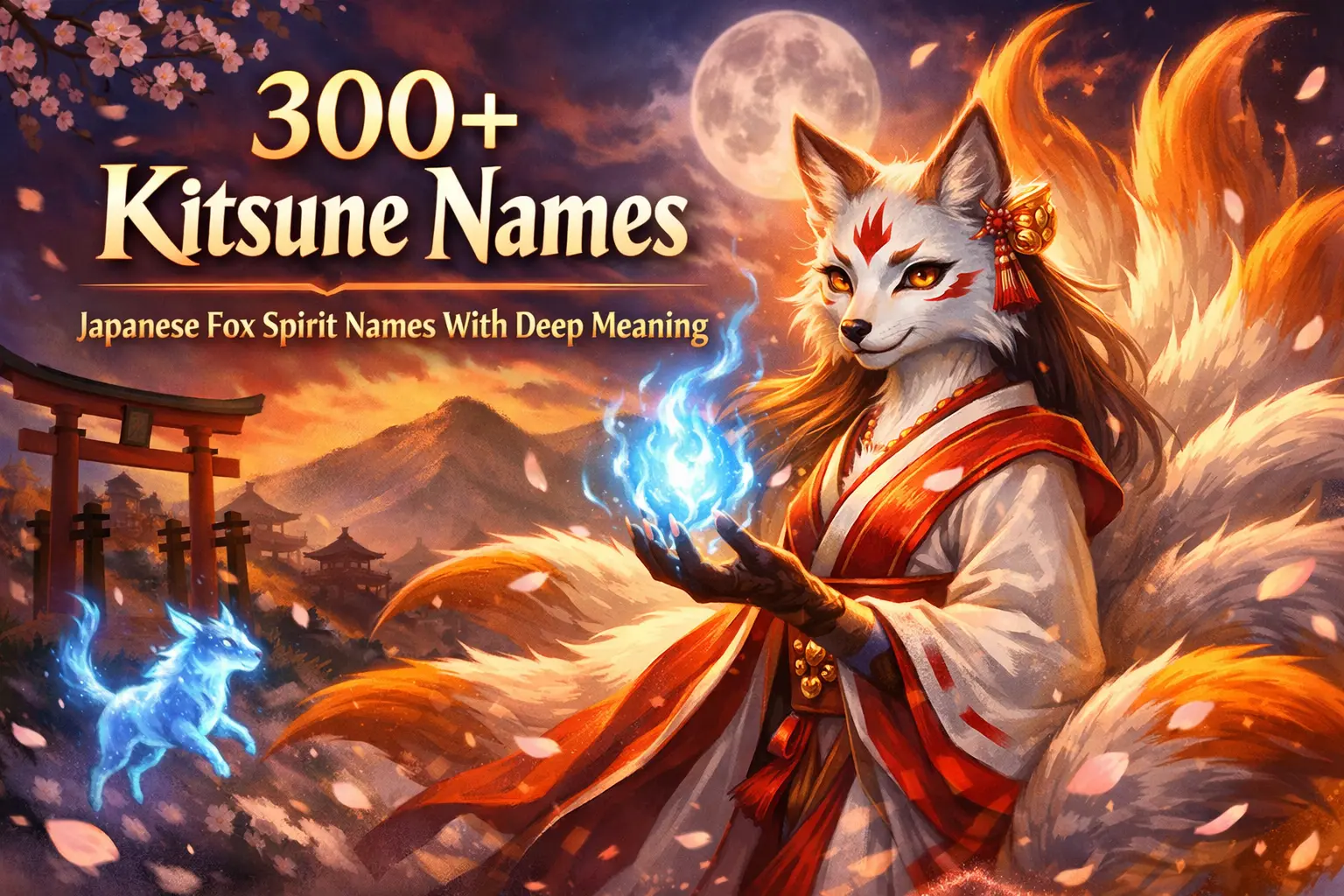
Kitsune names carry centuries of mythology inside them. If you’re building a character for anime, gaming, fantasy writing, or just personal creativity, the right kitsune name isn’t just cool-sounding. It feels like it belongs to something ancient, shape-shifting, and untameable.
This guide gives you over 300 kitsune name ideas organized by meaning, energy, and use, plus the cultural context that makes each category matter. Whether you want something dark, divine, fiery, or elegantly mysterious, you’ll find it here.
What Makes a Kitsune Name Different From Any Other Fantasy Name?
Kitsune (狐) in Japanese folklore are not just “fox spirits”. They are beings of transformation, intelligent, long-lived, and capable of accumulating spiritual power across centuries. Each tail they grow (up to nine) represents another hundred years of wisdom.
This matters for naming because kitsune names in authentic Japanese tradition often reflect:
- Elemental alignment (fire, wind, void, thunder)
- Moral alignment (zenko — benevolent, or yako — malicious)
- Shrine connection (many kitsune serve Inari, the Shinto deity of foxes, rice, and prosperity)
- Color symbolism (white = sacred, black = power, golden = celestial, red = trickster)
A name like Kitsunebi (fox fire) lands differently than a made-up fantasy name because it’s rooted in a real folkloric concept. That depth is what separates a forgettable character from one that feels lived-in.
If you enjoy building out a full mystical persona, you might also find value in exploring wizard names and samurai names, two traditions that share deep roots with kitsune mythology.
Female Kitsune Names (75 Names)
Female kitsune called mesu-gitsune in older texts are among the most iconic figures in Japanese folklore. They’re associated with seduction, cunning, emotional wisdom, and spiritual elevation.
Elegant & Mystical Female Kitsune Names
| Name | Meaning / Notes |
|---|---|
| Tamamo | “Jewel seaweed” — name of the legendary nine-tailed kitsune Tamamo-no-Mae |
| Kuzunoha | “Amber” — warm golden tones, one of the most evocative kitsune colours |
| Shirayu | “White flow” — ethereal and calm |
| Mizuki | “Beautiful moon” — elegant and widely used |
| Yukihana | “Snow blossom” — cold grace |
| Kageyuki | “Shadow snow” — dualistic, serene |
| Arashi | “Storm” — wild feminine power |
| Seiryu | “Clear dragon” — elemental and noble |
| Himari | “Sunflower” — rare warmth for a kitsune |
| Kohaku | “Amber” — warm golden tones, one of the most evocative kitsune colors |
| Tsukinami | “Moon wave” — beautiful for a celestial kitsune |
| Akami | “Red beauty” — fire-aligned |
| Nurako | “Docile one” — ironic name for a trickster |
| Shirogane | “Silver” — regal and cool |
| Kazehime | “Wind princess” — airy and untouchable |
| Fujiko | “Wisteria child” — delicate and haunting |
| Izayoi | “Sixteenth night moon” — the waning moon, melancholy and beautiful |
| Hotarubi | “Firefly light” — soft glow energy |
| Ruriko | “Lapis lazuli child” — deep blue mystery |
| Aoyuki | “Blue snow” — impossible and divine |
Dark & Dangerous Female Kitsune Names
| Name | Meaning / Notes |
|---|---|
| Kurohane | “Black feather” — ominous elegance |
| Akujo | “Wicked woman” — classic yako energy |
| Yamikaze | “Darkness wind” — fast and unseen |
| Shinikage | “Death shadow” — ominous nine-tail vibe |
| Jigokubi | “Hellfire” — scorched power |
| Noroi | “Curse” — blunt and chilling |
| Meikyo | “Dark mirror” — shows only lies |
| Akurei | “Evil spirit” — straightforward and striking |
| Yamibana | “Dark blossom” — contradictory beauty |
| Kakuriyo | “Hidden world” — she walks between realms |
Soft & Celestial Female Kitsune Names
| Name | Meaning / Notes |
|---|---|
| Inari | The goddess herself — powerful name for a divine kitsune |
| Shiromiko | “White shrine maiden” — serving the divine |
| Tsukikage | “Moonlight shadow” — luminous |
| Nagomi | “Harmony” — a healer kitsune |
| Hagoromo | “Feathered robe” — celestial garment of kami |
| Sora | “Sky” — open, limitless |
| Murasaki | “Purple” — regal, associated with nobility |
| Amateruko | A play on Amaterasu, the sun goddess |
| Oshiroi | “White powder” — references the pale complexion of transformed kitsune |
| Tenshi | “Angel” — for a nine-tailed heavenly fox |
More Female Kitsune Names
Ayame, Shinobu, Ruri, Nazuna (a flower kitsune love in legend), Hoshi, Satsuki, Komachi, Akane, Asahi, Haruka, Miyabi, Suzume, Tomoe, Yuki, Saya, Kasumi, Chidori, Nanao, Kireina, Tsurara, Hitomi, Nanami, Kirara, Retsuko, Misaki, Fujimi, Aiko, Kameko, Umeko, Sakurako, Yoruhi, Reika, Uzuki, Hanako, Nekomi
Male Kitsune Names (75 Names)
Male kitsune called osu-gitsune appear less often in Japanese folklore than their female counterparts, but carry tremendous spiritual weight when they do. They tend to embody trickery, protection, and elemental force.
Powerful & Traditional Male Kitsune Names
| Name | Meaning / Notes |
|---|---|
| Kuugen | Celestial fox god from the Wagaya no Oinari-sama tradition |
| Tobi | “Kite bird” — swift, hunting predator energy |
| Raijin | “Thunder god” — storm-aligned kitsune |
| Genko | “Dark fox” — rare male descriptor |
| Kazuma | “Harmonious true” — a grounded, ancient feel |
| Hayate | “Sudden sound of wind” — speed and chaos |
| Kenpachi | “Sword eight” — warrior fox |
| Akatsuki | “Dawn red” — liminal, between dark and light |
| Raikou | “Thunder light” — electric power |
| Touga | “East river” — steady, older energy |
| Kazan | “Volcano” — fire-aligned, destructive and creative |
| Ryuusei | “Shooting star” — celestial and fast |
| Tsubaki | “Camellia” — an unusual, beautiful male name |
| Souji | “Governing one” — noble and commanding |
| Kuroi | “Black” — simple, direct, menacing |
Dark & Trickster Male Kitsune Names
| Name | Meaning / Notes |
|---|---|
| Oni | “Demon” — used as a name for a chaos-aligned kitsune |
| Yamikuro | “Dark black” — compound of shadow |
| Jigoku | “Hell” — severe, powerful |
| Noroimaru | “Curse boy” — classic dark male suffix |
| Akuma | “Devil/demon” — self-explanatory but effective |
| Kurai | “Gloomy/dark” — for a morally ambiguous kitsune |
| Magatama | Sacred curved bead — associated with power and corruption |
| Fushigi | “Mystery” — unsettling calm |
| Kuroboshi | “Black star” — celestial darkness |
| Dokuro | “Skull” — death-touched kitsune |
Noble & Divine Male Kitsune Names
| Name | Meaning / Notes |
|---|---|
| Hakushi | “White master” — zenko, Inari-serving fox |
| Tenshiro | “Heaven four” — celestial numbering |
| Kōmoku | Derived from a guardian deity name |
| Shiro | “White” — classic purified fox |
| Ryokan | “Good hospitality” — a gentle, old-soul kitsune |
| Mikoto | “Noble/divine being” — suffix used for gods |
| Daigo | “Great enlightenment” — nine-tailed wisdom |
| Amane | “Sound of heaven” — rare, poetic |
| Kenzan | “Sword mountain” — power and stillness combined |
| Inoken | “Inari’s sword” — divine protector |
More Male Kitsune Names
Kaito, Riku, Haruto, Sora, Ren, Kei, Jin, Raiden, Tatsuya, Haru, Taiga, Sho, Yuki, Koga, Ryuken, Natsuo, Kotaro, Jiro, Saburo, Shingo, Aoto, Byakuya, Fujimaro, Ginjiro, Hakuro, Isamu, Jirouemon, Kamui, Masaru, Naoki, Osamu, Raizo, Seiji, Taro, Ukon, Veguro, Wataru, Yamato, Zenki
Dark Kitsune Names (40 Names)
Yako malicious kitsune are a distinct category in Japanese folklore. These beings possess humans, cause illness, and operate without moral restraint. A dark kitsune name should feel like a warning.
What separates a truly dark kitsune name from a generic villain name is subtlety. The most frightening kitsune in Japanese legend don’t announce themselves. They smile. They offer gifts. The darkness is layered.
If you love this category, our full list of names that mean evil and Japanese names that mean death goes much deeper.
| Name | Meaning / Energy |
|---|---|
| Yamikitsune | “Dark fox” |
| Jigokuhi | “Hell flame” |
| Noroi | “Curse” |
| Kuroyasha | “Black yaksha” |
| Akujin | “Evil god” |
| Shinikaze | “Death wind” |
| Meiko | “Dark child” |
| Dokusai | “Poison rule” |
| Kurayami | “Darkness” |
| Orochi | “Great serpent” — the destroyer |
| Akuryō | “Evil spirit” |
| Yokai | Category name used as personal identity |
| Zetsubou | “Despair” |
| Kageboshi | “Shadow star” |
| Shikigami | “Ritual spirit” — servants used for harm |
| Yamikoe | “Voice of darkness” |
| Kurohoshi | “Black star” |
| Jashinn | “Evil deity” |
| Tatari | “Curse/divine punishment” |
| Muzai | “Innocent” — ironic name for the most dangerous yako |
| Akunin | “Evil person” |
| Dokkaebi | Korean cognate spirit |
| Kagerō | “Heat haze” — deceptive, illusionary |
| Kokuen | “Black smoke” |
| Fumetsu | “Immortal” — but corrupted |
| Jigai | “Darkness” compound |
| Makoto | “Truth” — weaponized sincerity |
| Ressen | “Cold blade” |
| Yamifude | “Dark brush” |
| Shirotabi | “White journey” — the most dangerous are mistaken for divine |
| Akashic | Records-touching, all-knowing destroyer |
| Doroku | “Mud six” — primordial, ugly power |
| Nezumi | “Rat” — lowest, most cunning |
| Shiraha | “White blade” — divine weapon turned dark |
| Enki | “Fire demon” — Mesopotamian name that crosses mythologies beautifully |
| Kaburimono | “One who wears a mask” |
| Yamihana | “Dark blossom” |
| Ryōki | “Hunting demons” |
| Jotaro | “Hell too much” — overwhelming, destructive |
| Konton | “Chaos” |
Celestial & Nine-Tailed Kitsune Names (30 Names)
The kyubi no kitsune nine-tailed fox is the pinnacle of kitsune power. These names should carry weight. They should feel earned.
Nine-tailed kitsune in Japanese mythology serve Inari directly and are considered near-divine. In Chinese mythology (huli jing), the nine-tailed fox is associated with good omen and the empire. In Korean mythology (gumiho), they’re often more sinister.
| Name | Meaning / Notes |
|---|---|
| Kyūbi | “Nine tails” — the name itself |
| Hakumen Kinme | “White face, golden eyes” — legendary kitsune from Chinese records |
| Daji | Chinese nine-tailed fox who toppled the Shang dynasty |
| Miho | “Beautiful treasure” — Inari’s celestial fox |
| Tenko | “Heavenly fox” — the highest rank of kitsune |
| Byakko | “White tiger” — shares celestial energy with white kitsune |
| Kōjin | “Fire god” — a divine kitsune aligned with sacred flame |
| Shinpei | “Divine soldier” |
| Amakitsune | “Heavenly fox” |
| Inari-Kami | For a kitsune who is the deity |
| Tenshin | “Heavenly being” |
| Taiyōkō | “Solar light” — rare fire-celestial hybrid |
| Raijūkō | “Thunder beast light” |
| Suijin | “Water god” — rare water-element nine-tail |
| Shinjitsu | “Divine truth” |
| Ameno | “Of heaven” |
| Fujin | “Wind god” |
| Shirohoshi | “White star” |
| Taihaku | “Great white” — the brightest star |
| Kakushi | “Hidden one” |
| Mugen | “Infinite” — nine tails, endless power |
| Reimei | “Dawn” |
| Mikagami | “Sacred mirror” — one of the three imperial treasures |
| Magatama | “Curved jewel” — another imperial treasure |
| Kusanagi | “Grass cutter” — the divine sword, for a warrior nine-tail |
| Ōkami | “Great god” (also “wolf” — a beautiful kitsune-wolf ambiguity) |
| Izanami | The goddess of death — for a nine-tail who guards the underworld |
| Susanoo | The storm god — for a chaos-aligned nine-tail |
| Tsukuyomi | Moon god — for a lunar kitsune |
| Amaterasu | The sun goddess — the ultimate divine kitsune name |
Fire Kitsune Names (25 Names)
Kitsunebi fox fire is one of the most iconic elements of kitsune mythology. These floating fireballs light the path of fox wedding processions and serve as omens. Fire kitsune names should feel alive, unpredictable, and consuming.
| Name | Meaning / Notes |
|---|---|
| Kitsunebi | “Fox fire” — the phenomenon itself as a name |
| Homura | “Flame” — clean, iconic |
| Kōka | “Fire flower” |
| Enka | “Flame song” |
| Kaen | “Blaze” |
| Akahono | “Red flame” |
| Moeru | “Burning one” |
| Hibana | “Spark” |
| Tatsu-hi | “Dragon fire” |
| Honoo | “Flame/blaze” |
| Kasai | “Conflagration” |
| Rekka | “Raging fire” |
| Shakunetsu | “Scorching heat” |
| Gouka | “Hellfire” |
| Taiyo | “Sun” — the ultimate fire |
| Ensho | “Flame rising” |
| Hono-o | Alternate spelling of flame |
| Kazan-hi | “Volcano fire” |
| Akasuki | “Red mist” — fire and air combined |
| Benihana | “Red flower” — fire blossoms |
| Enjin | “Flame person” |
| Moekko | “Little burning one” |
| Raika | “Thunder fire” |
| Shinra | “Divine fire” |
| Enbu | “Flame dance” |
Shadow & Moon Kitsune Names (25 Names)
Not all kitsune are fire. Some align with the moon, shadow, and void operating in the spaces between things.
| Name | Meaning / Notes |
|---|---|
| Kage | “Shadow” |
| Tsukimi | “Moon-viewing” |
| Yūrei | “Faint spirit” |
| Oboro | “Hazy/misty moon” |
| Kagero | “Heat shimmer” — visual distortion |
| Meigetsu | “Harvest moon” |
| Kuroyami | “Deep darkness” |
| Yoru | “Night” |
| Mikadzuki | “Crescent moon” |
| Tasogare | “Twilight” |
| Mugen | “Void/infinite” |
| Kagemaru | “Shadow circle” — a traditional male suffix |
| Kurai | “Dark/dim” |
| Nagareboshi | “Shooting star” |
| Higure | “Dusk” |
| Yamikaze | “Dark wind” |
| Otsuki | “Great moon” |
| Kōgetsu | “Bright moon” |
| Yūgure | “Evening” |
| Shirakage | “White shadow” — impossible contrast |
| Tsukiyo | “Moonlit night” |
| Anko | “Dark light” |
| Meikō | “Dark gleam” |
| Yokan | “Premonition” |
| Mayonaka | “Midnight” |
Kitsune Names for Gaming & Fantasy Characters (40 Names)
If you’re building a kitsune for D&D, an RPG, an anime OC, or a fantasy novel, these names balance authenticity with memorability. The best gaming names are ones that sound Japanese without requiring a mythology degree to pronounce.
For more gaming character inspiration, explore cool gaming names, cyberpunk names, and vampire names kitsune often inhabit the same mythological space as these archetypes.
| Name | Why It Works |
|---|---|
| Foxen | Western phonetics, kitsune soul |
| Ryoku | “Green strength” — unusual color energy |
| Silverbane | English compound, instantly evocative |
| Ashkitsune | “Ash fox” — post-battle |
| Kurenai | “Crimson” — famous from Naruto but genuinely beautiful |
| Kyoko | “Mirror child” — a kitsune’s nature reflected |
| Fenrix | Fantasy phonetics meets fox spirit |
| Talon | Sharp and sudden |
| Emberfox | Elemental + animal |
| Nullen | “Void one” — for a kitsune of the void element |
| Sable | “Black” in heraldry — sleek |
| Ashenveil | English compound, shadowy |
| Mistpaw | Gentle, almost cute — for a trickster who seems harmless |
| Gilded | Gold without being obvious |
| Verdant | Rare nature-kitsune energy |
| Specterkin | Ghost-fox hybrid concept |
| Vexen | “Troublemaker” energy, fantasy-ready |
| Drifter | Perfect for a wandering kitsune |
| Wraith | Simple, effective |
| Phantom | Classic |
| Cinder | Fire but subtle |
| Solaris | Sun-aligned nine-tail |
| Noctis | “Night” in Latin — cross-cultural |
| Ember | Warm, glowing |
| Starfall | Celestial event |
| Hollowpeak | Haunted mountain energy |
| Riftwalker | Between-world kitsune |
| Glimmer | Small but potent |
| Tessera | “Fragment/tile” — a kitsune of many faces |
| Vespera | “Evening star” — Latin |
| Auris | “Gold” in Latin |
| Nimbus | “Cloud/aura” |
| Calix | “Chalice” — ceremonial kitsune |
| Zephyr | Wind-aligned |
| Lyric | For a music kitsune who enchants through song |
| Sylva | Forest-aligned |
| Crest | Noble and simple |
| Draven | Dark but not overdone |
| Kira | “Glitter/sparkle” — Japanese |
| Haze | Deceptive and atmospheric |
Cute & Playful Kitsune Names (20 Names)
Not every kitsune is ancient and terrifying. Young kitsune (ko-gitsune) are curious, mischievous, and energetic. These names capture that energy, great for a familiar, a companion character, or a lighthearted design.
| Name | Notes |
|---|---|
| Chibi | “Tiny/small” |
| Koko | Simple, sweet, foxlike sound |
| Tama | “Jewel” — a beloved pet name |
| Mochi | Soft and round, like a baby kitsune |
| Piko | Diminutive, playful |
| Kuri | “Chestnut” — warm and small |
| Fuku | “Good fortune” — a cheerful kitsune |
| Pyon | Jumping/bouncing sound |
| Yuki-chan | Snow, affectionately |
| Hachi | “Eight” — one tail away from legendary |
| Kotaro | “Little Taro” — traditional and cute |
| Mimi | “Ears” — perfect for a fox |
| Suki | “Loved one” |
| Tori | “Bird” — a kitsune who moves like a bird |
| Fuwa | “Fluffy” |
| Kira-chan | Sparkle girl |
| Yoyo | Playful sound |
| Piyo | Baby-bird sound |
| Niko | “Smile” |
| Shiro-chan | Little white fox |
Kitsune Names by Tail Count
One of the most unique ways to name a kitsune is to reference their spiritual rank. Each tail is a century of life and power.
| Tails | Name Suggestion | Meaning |
|---|---|---|
| 1 tail | Hitori | “One person” — just beginning |
| 2 tails | Niko | “Two light” |
| 3 tails | Sanbi | “Three tails” — the traditional minimum for beginning magic |
| 4 tails | Shibi | “Four tails” |
| 5 tails | Gobi | “Five tails” — halfway |
| 6 tails | Rokubi | “Six tails” |
| 7 tails | Nanabi | “Seven tails” — approaching divinity |
| 8 tails | Hachibi | “Eight tails” — one step from godhood |
| 9 tails | Kyūbi | “Nine tails” — the pinnacle |
Expert Observations: What Most Kitsune Name Lists Get Wrong
1. They Ignore the Moral Spectrum
Most lists just give you “cool-sounding Japanese words.” But kitsune exist on a defined moral axis: zenko (benevolent) vs. yako (malicious). The name should reflect which side of that axis your kitsune stands on or whether they straddle it.
A zenko kitsune might carry names rooted in light, purity, and Inari’s shrine (Hakumei, Tenshiro). A yako kitsune should have something that hides danger inside beauty (Muzai — “innocent” — is more terrifying than Akuma — “demon”).
2. They Use Japanese Words Without Folkloric Grounding
“Sakura” is a beautiful Japanese word. It’s a terrible kitsune name unless your kitsune has a specific connection to cherry blossoms and impermanence, which is actually a rich theme to explore. The point: know why you’re choosing a name, not just that it sounds Japanese.
3. They Forget the Chinese and Korean Parallels
The kitsune tradition doesn’t exist in isolation. Chinese huli jing and Korean gumiho are cognate traditions with their own naming conventions. A Chinese-origin nine-tailed fox might carry a name like Daji, Suijin, or Fenghuang (phoenix). A Korean gumiho might go by Miho, Yeoul, or Chaerin. Cross-cultural naming can make a character feel richer and more researched.
Kitsune Names for Specific Character Types
For a Kitsune Shrine Guardian
Hakubi, Inariho, Tenshin, Mikagami, Shinjitsu, Amakitsune, Enshrine, Byakurei
For a Kitsune Assassin
Kagerō, Shinikaze, Muon (“silent”), Hizen, Yamikoe, Noroimaru, Satsui (“bloodlust”), Kageboshi
For a Shape-Shifting Trickster
Kagemai (“shadow dance”), Kagami (“mirror”), Bakeru (“to transform”), Fushigi, Muzai, Henka (“change”)
For a Kitsune Scholar or Sage
Chie (“wisdom”), Richi (“reason/logic”), Gakumon (“learning”), Kenshi (“wise master”), Hakase (“professor/doctor”)
For a Kitsune Warrior
Kenzan, Inoken, Raijin, Kenpachi, Ressen, Toshiro, Katsujin, Raiko
Internal Mythology Note: Why Kitsune Names Matter More Than People Think
When you name a kitsune, you’re not just labeling a character. In Japanese belief, a name (namae) carries spiritual weight — the concept of kotodama holds that words have power. A kitsune who knows your true name holds power over you.
This is why many kitsune in folklore never reveal the real names they go by titles, descriptions, or the names humans give them. When building a kitsune character, consider: Does your character have a true name? Is it the one they offer, or something hidden deeper?
That narrative layer, the name behind the name, is what elevates a kitsune character above other fantasy archetypes. For a similar approach with a different tradition, look at how druid names and ghost names often carry this same hidden-truth quality.
FAQs About Kitsune Names
What is the most famous kitsune name in Japanese mythology?
Tamamo-no-Mae, a nine-tailed kitsune who disguised herself as a courtesan to Emperor Toba. She’s considered one of the three great evil spirits of Japanese legend. The name means “jewel seaweed”, which proves kitsune don’t always choose obviously menacing names.
What does “kitsune” literally mean?
The most accepted folk etymology is kitsu-ne “come and sleep”, referencing the idea of a fox that appears in human dreams. Linguistically, it combines kitsune (狐) as an onomatopoeia for fox sounds. Scholars debate the exact origin, which itself feels very kitsune.
Can a kitsune name come from non-Japanese sources?
Yes especially in gaming and fiction. If your kitsune is set in a world with cross-cultural mythology, names from Chinese (huli jing tradition) or Korean (gumiho tradition) work beautifully. Words from Sanskrit, which influenced East Asian spiritual vocabulary, also blend naturally.
Are there English kitsune names that work well?
Yes. “Ember,” “Mist,” “Veil,” “Shadow,” “Gilded,” and “Drift” all work because they reference the qualities of kitsune fire, illusion, concealment, without forcing Japanese phonetics. The best English kitsune names are thematic, not imitative.
What’s the difference between a zenko and a yako name energy?
Zenko’s names tend toward light imagery, celestial references, and Inari’s shrine. Think: white, gold, moon, heaven, shrine maiden. Yako names carry shadow, inversion, and hidden menace. Think: darkness that smells like flowers, innocence as a weapon, names that mean “truth” used by liars.